My cousin, who's now an engineer, hated school and even Calculus until he finally took a class he could use: Differential Equations (affectionately known as "diffy q's").
Your algebra, geometry and precalculus teachers will tell you the reason to learn all the stuff in their classes is that you'll need it in calculus. But what's calculus for?
In the 1600s Descartes put algebra and geometry together for the first time, allowing others like Fermat to make progress on finding slopes of curved functions and areas under curves. Newton and Leibniz systematized the process and it became Calculus with a capital C.
But it all would have remained abstract, "pure" math if not for the fact that scientists were able to use the new math notation (Leibniz's, anyway) for modeling situations they found in nature. Situations where you didn't know the value for something (heat, for example) but you knew how fast it changed were all of a sudden able to be modeled using differential equations like dy/dt = ky.
Of course Newton made the most notable use of his new invention to solve the differential equations he encountered in his astronomical studies. His solutions proved Kepler's laws to be correct and that his own famous laws applied to objects on earth and in the heavens.
Textbooks are written every day about solving differential equations using algebra and integration. Instead of the change in y you get a formula for y itself. Take the differential equation
dy/dx = y - x
We're looking for a function y whose derivative is the original function y minus x. In school you jump through all kinds of hoops to find the solution for y is
y = ce^x + x + 1
Take the derivative of that function and sure enough, it's the function minus x. Well, those differential equations have all been reduced to algebraic formulas thousands of times, and more with every school year. Furthermore, most of the differential equations that are encountered in the real world have no explicit solution with x's and y's. This situation was already well known in the 1700s, leading Euler to develop "numerical methods" of approximating solutions using "Euler's Method."
If you know one value (an initial value, say) of y but otherwise you only know how it changes, you can start at that value and just take steps using the direction given by the differential equation. If the steps are small enough, you can get a good approximate graph of the function y. Euler's Method has been improved over the years, and now it's even made into highly instructive Java applets. Every so often somebody codes these methods into a new free differential equation solver software to help, like Calcode or Maxima.
So we do Algebra and Geometry to do Calculus, but we do Calculus in order to solve Differential Equations. The faster we get to Diffy Q's the better. I introduce them in the third meeting of the Math Through Technology Program, starting September 6th.
Tuesday, July 31, 2012

Monday, March 19, 2012
Math Stuff That Used To Make Sense Part I: Rationalizing Denominators
In the 21st century math teachers are still making students "rationalize the denominator," because a square root in the denominator is a crime against nature. Well, there actually used to be a good reason for not wanting a never-ending, never-repeating decimal in the denominator of a fraction, but we'd have to think back before calculators.
Supposedly, the first mathematician to insist the diagonal in a perfect 1x1 square can't be expressed as a whole number or a fraction was put to death. Irrational numbers have been given a bad name, but they come up very often in geometry and trigonometry, thanks to the Pythagorean Theorem. The "special triangles" so beloved by the SATs contain Ö2 and Ö3.
Why can't you just leave square roots in radical form? Well, in the real world, you never give your friend directions like "go Ö17 miles down the road and turn left." There is an effective but confusing and annoying algorithm to compute square roots which reminds me of long division and not in a good way.
So there used to be tables of square roots in the back of textbooks, or students used to memorize square roots using mnemonic devices, in case you weren't allowed to use your notes or a table (or a slide rule) on the test.
"For the square root of 2
I wish I knew" = The number of letters in each word is 1, 4, 1, 4. The square root of two is 1.414...
"To know the square root of 3
O charmed was he" = 1.732
"To know the root of 5
So we now strive" = 2.236
That was the reason for making students reduce irrational numbers like Ö75 to 5Ö3. They're both 8.660... but before calculators we memorized the square root of 3 but not the square root of 75. We wanted a form we could get a couple of decimal places out of, and multiplying 1.732 by 5 was a cinch compared to having to do the square root algorithm on 75 every time. Of course, now with calculators, there's no longer any need to reduce roots like this.
Similarly, before calculators, expressing the cosine of 45 degrees as 1/Ö2 would make your heart sink. Imagine trying to do long division, dividing 1 by a never ending, never repeating decimal. Echhh. So you "rationalized the denominator" and came up with Ö2/2. Dividing a long number by two is pretty easy in comparison. Both expressions give you 0.7071...
But nowadays? Come on: Ö2/2 and 1/Ö2 require the exact same number of keystrokes on your calculator to get 0.7071.... I submit there is absolutely no reason to continue to teach this outdated arithmetic to students, and to penalize students who write 1/Ö2 instead of Ö2/2.
Saturday, February 18, 2012
Real Math vs. School Math
I made a video presenting some background on how math is taught in schools. My opinion is that learning to really use math tools should take a lot less time than we're led to believe. Hope it starts a dialogue!
Thursday, June 30, 2011
A Little Algebra
Here's a problem that's nearly impossible to solve until you use a (very) little algebra, and then you can generate an infinite number of solutions:
Can you think of two numbers that give you the same result when you add them as when you multiply them? For example, 2 + 2 = 2 x 2, and there's another trivial solution, but are there any solutions to this when the numbers aren't the same? What if you include fractions or decimals?
If you try to guess and check your way to a solution, it seems impossible. But believe it or not, there are an infinite number of pairs that work. All you have to do is use a little algebra.
Translate this sentence into symbols: "Multiplying two numbers, x and y, is the same as adding x and y."
xy = x + y
I agree, this doesn't automatically lead to a list of solutions for me, either, but plug in a number for y and solve for x:
3x = 3 + x
2x = 3
x = 3/2
Sure enough, 3 (3/2) = 3 + 3/2 = 4.5
Plug in 4:
4x = 4 + x
3x = 4
x = 4/3
4 (4/3) = 4 + 4/3 = 5 1/3
See a pattern yet? It's pretty easy to generate tons of pairs of numbers that work now, having taken the most elementary step into algebra land. And that's the only reason to go there, in my opinion: to solve a real problem.
Tuesday, June 7, 2011
Series Join The Series
It was always a mystery to me why in Calculus we stopped learning the fun geometrical stuff like curves, areas and volumes and all of a sudden started learning about series. The professor never mentioned why this topic was necessary. So much for context. He also couldn't teach series very well, and I had to take the class over during the summer to graduate.
I dare you to ask your math teacher what series have to do with Calculus. "Well, they're on the AP exam," is the response you're likely to get, and that's true, too. But the real reason is that polynomials are child's play to differentiate and integrate, and many other functions are not. In Visual Complex Analysis, Professor Tristan Needham of USF writes that
Newton's 1665 version of the calculus was different from the one we learn today: its essence was the manipulation of decimal expansions in arithmetic. The symbolic calculus...was also perfectly familiar to Newton, but apparently it was of only incidental interest to him. After all, armed with his power series, Newton could evaluate an integral like ∫ e-x2dx just as easily as ∫ sin x dx. Let Leibniz try that!That very integral (∫ e-x2dx) stumps most calculators, and I assume most students as well. But in the Series module participants in The Fun Calculus Program learn how to derive the series for ex, and simply substitute -x2 for x.
Personally, I love how Calculus tools evolved to make easy work of previously unsolvable problems, and series fit right into that toolbox.
Saturday, February 12, 2011
The Square Root of the Square Root of -1
So your precalculus teacher tells you the square root of -1 is i. Did you ever ask her what the square root of i is? You'll either get a dirty look or an interesting exploration into complex numbers that will probably last twenty minutes into your lunch block.
As I said in the previous post, mathematicians learned they'd have to deal with the square roots of negative numbers as if they were just another letter in algebra. Eventually they reasoned that multiplying by -1 was like a 180 degree rotation around 0. Well, what if you did that in 2 steps?
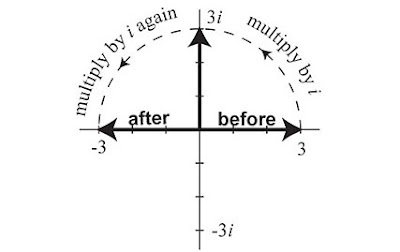
The vertical axis was renamed the imaginary axis, so complex numbers like a + bi could be expressed as points. Multiplying by the square root of negative one will get you halfway around, then multiplying again will get you the full 180 degrees. So multiplying by the square root of -1 is like a 90 degree rotation.
But what about the square root of i? That can be solved in a similarly geometric fashion. Just make the 90 degree rotation in two steps, each one being the square root of i. And each step will be a 45 degree rotation:

Using the 45-45-90 special triangle formula, the point is 1/sqrt(2) in the horizontal direction and 1/sqrt(2) in the vertical direction. 1/sqrt(2) is around .7071, and if you square 1/sqrt(2) + i/sqrt(2) you'll get i.
(1/sqrt(2) + i/sqrt(2))2 = 1/2 + 2i/2 + i2/2 = 1/2 + i - 1/2 = i
Actually, if you did a rotation of 225 degrees twice you would rotate all the way around and back to 90 degrees, so that gives another square root of i.
Friday, February 11, 2011
Trig Identities
After working with a student whose teacher has been covering trig identities for weeks (!), I was lucky enough to stumble on the way those abstract exercises were invented.
Trig functions (sine, cosine and tangent) are ratios of the sides of a right triangle, and there are certain relationships between them that can be exploited for fun and profit. For example, (sinA)2 + (cosA)2 = 1, so you can replace (sinA)2 with 1 - (cosA)2.
In the days before calculators, it was useful to be able to find the trig function of an angle just by knowing the function of a related angle, like half of A. These "double angle" formulas can be derived using a little algebra and geometry and are still trotted out in the 21st century:
sin2A = 2sinAcosA and cos2A = 2(cosA)2 - 1
I can see some value in not wanting to do integration on a function involving a square or a product, so being able to substitute a straight double angle function might be preferable. Of course, trig identities are taught long before calculus, so I have no idea what reason precalculus teachers give for still teaching them, other than they're (at best) interesting brainteasers.
The trig identities my student was being asked to prove were for larger angles, like 3A and 4A, requiring more algebra, and departing ever more from real applications. I wondered how mathematicians were able to discover a relation like cos4A = 8cos4A - 8cos2A + 1. Elsewhere, I've shown how we proved this identity using cos2A = 2(cosA)2 - 1 but after weeks of sleepless nights and cornea-searing research I finally found the mysterious trig identity generator.
Once mathematicians discovered how to deal with crazy numbers like the square root of -1 using algebraic shorthand, they quickly started playing around with coordinate systems to visualize the strange numbers.
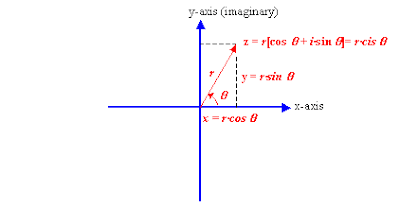
As you can see in the figure above, any point can be expressed as r(cosA + i sinA) or rcisA. It seems like a long-winded way to express a number like (3, 4) or 3 + 4i, but the trig form has the advantage of being able to multiply, divide and take complex numbers to any exponent very easily. De Moivre's Theorem is the shortcut:
r1cisA * r2cisB = r1r2cis(A+B)
r1cisA / r2cisB = (r1/r2)cis(A-B)
and most importantly, (rcisA)n = rn (cos(nA) + i sin(nA))
Easy, huh? For example, taking r = 1 and n = 4:
(cosA + i sinA)4 = cos(4A) + i sin(4A)
This can be made easier using Pascal's Triangle to help expand (a + b)4:
(a + b)4 = a4 + 4a3b + 6a2b2 + 4ab3 + b4
Now replace a with cosA and b with i sinA:
cos4A + 4cos3A i sinA + 6cos2A i2 sin2A + 4cosA i3 sin3A + i4 sin4A
so cos(4A) + i sin(4A)
= cos4A + 4cos3A i sinA - 6cos2A sin2A - 4cosA i sin3A + sin4A
The real part of the left side of the equation must equal the real parts of the right side:
cos(4A) = cos4A - 6cos2A sin2A + sin4A
Now replace sin2A with 1 - cos2A:
cos(4A) = cos4A - 6cos2A (1 - cos2A) + (1 - cos2A)(1 - cos2A)
cos(4A) = cos4A - 6cos2A + 6cos4A + 1 - 2cos2A + cos4A
cos(4A) = 8cos4A - 8cos2A + 1
And that's how those sneaky mathematicians generated the identity my student and I worked so hard to prove. Next time: i is the square root of -1, but what is the square root of i??
Subscribe to:
Comments (Atom)